My research focuses on how digital health tools, patient-generated data, and AI can be used more responsibly and meaningfully in women’s reproductive health. I study conditions such as endometriosis, fibroids, adenomyosis, menstrual disorders, and chronic pelvic pain, with a focus on building digital evidence that is trustworthy, interpretable, and clinically useful.
Why this work matters
Women’s reproductive health conditions are often difficult to study and manage because symptoms are variable, documentation is inconsistent, and conventional clinical data often miss what matters most in daily life. My work asks how digital data can improve research, inform care, and make women’s health evidence more precise, equitable, and actionable.
How can digital health data become clinically meaningful rather than merely abundant?
How do we make women’s health conditions that have historically been under-measured more visible, interpretable, and useful in research and care?
Research Themes
My work sits at the intersection of women’s health, digital health, and computational methods, with a focus on building evidence that is rigorous and usable in real-world care.
Building better digital evidence
I study how patient-generated data can help characterize conditions that are cyclical, heterogeneous, and often poorly captured in routine care.
Making data clinically interpretable
Collecting more data is not enough. I examine how statistical and computational methods can turn complex symptom and behavioral data into measures that patients and clinicians can actually use.
Designing more equitable digital health
I study how mobile health tools can help bridge gaps in access, support self-management, and extend meaningful resources to populations and conditions that have historically been under-served or under-studied.
Patient-generated data in reproductive health
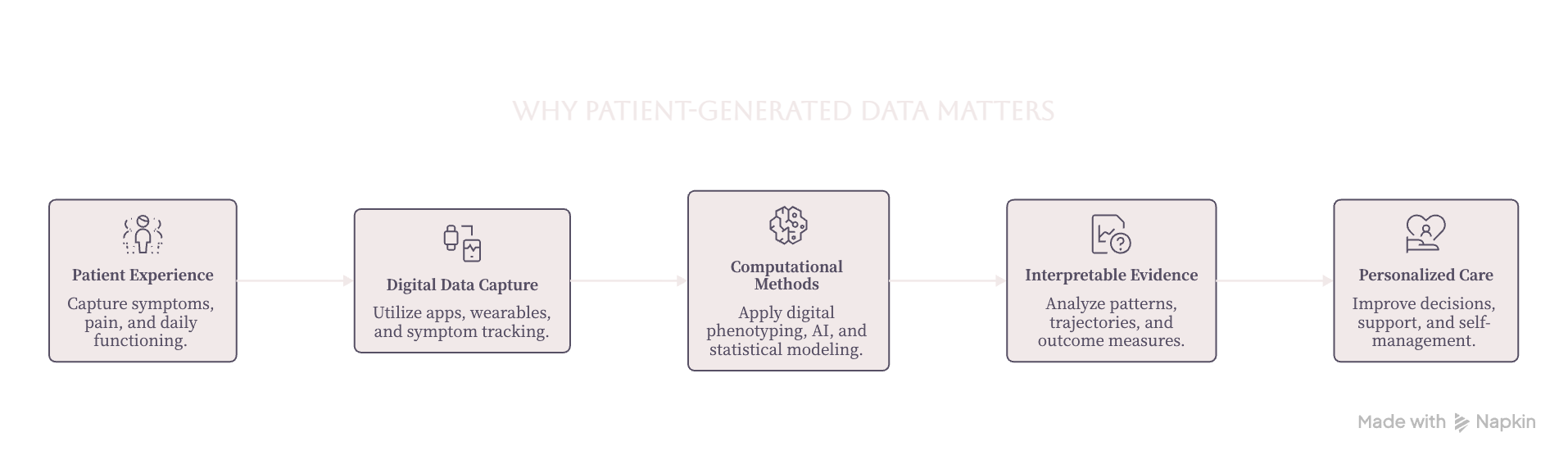
A central theme across my work is how patient-generated data can help make women’s reproductive health conditions more visible and better understood. Because symptoms often fluctuate over time and affect many dimensions of daily life, longitudinal and context-rich data can add information that routine clinical records often miss. I have contributed to work using participatory and mobile health approaches to better understand endometriosis and related conditions, including collaborations connected to the Phendo app and the broader Citizen Endo effort at Columbia University.
Why patient-generated data matters
One reason conditions such as endometriosis remain difficult to study and manage is that their symptoms are dynamic. Pain, fatigue, bleeding patterns, function, and treatment response may vary across days, weeks, and individuals in ways that static clinical encounters cannot fully capture.
Traditional clinical records remain important, but they are often incomplete, sparse, or not structured to reflect everyday symptom experience. Patient-generated data can help fill that gap by adding repeated, contextual information about symptoms, behaviors, and lived experience over time.
My research asks how those data can be collected, summarized, and interpreted in ways that support better phenotyping, more meaningful outcome measurement, and more personalized care.
Digital phenotyping and computational methods
Current areas of focus include digital phenotyping, functional data analysis, and models that can capture temporality and “critical windows” in patient-reported and mobile health data.
Pain, physical activity, and self-management
Another theme across my work is how movement, physical activity, and other non-pharmacological strategies can support symptom self-management and long-term health in chronic pain conditions. We recently conducted the first of its kind AI-driven personalized exercise intervention for pelvic pain management, primarily endometriosis, with the goal of informing more realistic and personalized recommendations. Click right to learn more.